Archive - Fiction RSS Feed

Hometown Prophet by Jeff Fulmer

HometownProphetThe Scriptures promise that in the latter days, God's people will prophesy. So what happens when God start sending visions Old Testament-style to a rather unlikely fledgling follower living in the buckle of the Bible Belt?

Under Jeff Fulmer's guidance, Nashville's recent historical events take on an apocalyptic tone. The results are explosive.
Continue Reading...

Top 10 Books of 2011

In no particular order, here are my 10 favorite books of 2011. Click on the titles to see my full reviews. If I haven't reviewed the book, then it'll take you to the Amazon page.

Fiction

Night of the Living Dead Christian by Matt Mikalatos

For my review of this book, click here.

Matt joins up with a ragtag group of monsters who are all seeking transformation. Their mission is to save Luther Martin, a werewolf whose inner beast has cost him his family. Along the way, Matt and his new friends learn what it really takes to find spiritual transformation.

This book is outstanding. We need more totally silly, totally serious theology like Matt gives us. Not everyone will enjoy the monster metaphor, but if that's your cup of tea, then you need this book. It'll make you take a hard look at the monstrous aspects of your own soul. And you'll ache for the same transformation Matt and his band of monsters discover. While laughing the whole time.

Continue Reading...

Batman: The Black Mirror by Scott Snyder and Jock

 This review is super-spoilery. If you haven't read The Black Mirror yet, do yourself a favor and go grab a copy ASAP. You won't regret it.

Click any of the pictures for a larger version of the image!

No matter who we are, we can't escape our past. Where we've come from and who we've been leave indelible marks on us. Nowhere is this more true than Gotham City, and in Batman: The Black Mirror, Scott Snyder gives us a glimpse into the Darkness that lies at the core of the city.

Continue Reading...

Interview with Author Matt Mikalatos

Back in October, author Matt Mikalatos released his excellent sophomore novel Night of the Living Dead Christian. I've already reviewed the book here, so you already know why you should read it. But Matt has graciously agreed to an interview on my blog. I got the chance to ask him a few questions about where the ideas for his book came from, and how he uses the monsters metaphor to explore spiritual transformation. Here's what he had to say:
Continue Reading...

The Leftovers by Tom Perrotta

Macmillan Audio has graciously offered to give one free copy of the audio book The Leftovers to one of my readers! Here's how you win:

  1. In the comments, answer this question: What's the worst piece of Rapture propaganda you've ever seen? (You may also invent your own. Make sure it's bad!) 
  2. Share this post on Twitter or Facebook! (you can use the sharing bookmarks at the bottom of the post)

I'll select the winner randomly on Wednesday, October 12. Spread the word!

The Leftovers asks a fascinating question: suppose the Rapture actually happened. Do you think it would fundamentally change human nature? Tom Perrotta thinks not, and thus the heart of The Leftovers, which after a brief prologue opens three years after what has become known as the “Sudden Disappearance” in which millions of people all over the globe simply vanished. At first, everyone assumed it to be the Rapture, but the vanished shared nothing in common – including religion. With no clear explanations available, humanity is left to make sense of the event on our own. Three years out, we get to live with the survivors in the small town of Mapelton – the Leftovers as many of them think of themselves – as they try to make sense of a world that’s fundamentally changed. Unsurprisingly, plenty of people are still convinced that the Sudden Disappearance was the Rapture, and that the world therefore has a quickly-expiring shelf life. The despair this evokes in them is palpable, as in the case of Laurie, a housewife whose family survives intact:
Deep in her heart, as soon as it happened, she knew. She'd been left behind. They all had. It didn't matter that God hadn't factored religion into His decision-making - if anything, that just made it worse, more of a personal rejection.
Laurie can’t come to terms with her rejection, so she joins the Guilty Remnant, one of several cults that springs up in the wake of the Sudden Departure. The G. R., as they’re called, wear all white and take a vow of silence. They smoke cigarettes as a sacrament, to remind themselves daily that they are guilty and deserve death. They follow everyday citizens around Mapleton, staring at them, interrupting their daily routines to remind them that they’re all leftovers. A few others (including Laurie’s collegiate son Tom) join a national following surrounding a charismatic hugger who gets caught up in his own press, styling himself “Holy Wayne” and making wild messianic promises in the midst of growing scandal. We catch wind of another movement of neo-hippies who call themselves the Barefoot People. They paint bullseyes on their foreheads “so the Creator will recognize us.” 031110_1009_Youmaybeare1More disturbing to me was the Reverend Matt Jamison, Mapleton’s lead rapture-denier. Jamison becomes obsessed with proving that the Sudden Departure couldn’t have been the Rapture. He proves it (to everyone, it seems, but himself) by publishing a monthly gossip rag that runs as much dirt and scandal on anyone who disappeared that Jamison could find. Rev. Jamison is one of The Leftovers’ ugliest characters. The amount (and variety) of religious fervor that breaks out in the wake of the Sudden Disappearance isn’t surprising, and Perrotta handles each group with respect. None of them seem like caricatures – they’re all disturbingly believable.

The surprise is that most people just try to move on with their lives, get back to business as usual as best as they can.

060911-F-9471G-005That seems to be Perrotta’s take on human nature. The Sudden Disappearance and its aftermath bear an uncanny, undeniable resemblance to our post-9/11 world. A tragedy too large for us truly to process with any sort of clarity forces itself upon our collective cultural consciousness and we change – sometimes for the better, but often for the worse. In reading The Leftovers, we meet people that we know, because they’re everyday people, just like we are. The Hero Parade that marks the third anniversary of the Sudden Disappearance reminds us of how uneasy we are with death, how quickly we deify the dead. How easily we celebrate the victims of a tragedy as heroes for no better reason that that they’re gone and we’re here, as though our celebrations are some form of survivors’ guilt. Kevin, Laurie’s husband and new mayor of Mapleton understands this as he thinks about a townsperson receiving a memorial celebration:
Personally, he hadn’t been all that crazy about Ted Figueroa… but this wasn’t the time or place for honest about the dead.
The Leftovers reminds us that our grief is mainly for us. That our grieving can actually keep us from moving forward. Grieving well is essential to our healing. I’m sure plenty of Christians will pick up this book thinking it’s a new Left Behind series. When they do, they’ll be sorely disappointed. Perrotta is not writing from a particularly religious perspective, nor does he assume that LeHaye and company’s predictions are all that accurate.* As he himself said in an interview with CNN’s Belief Blog:
[This book is] not a theological argument with apocalyptic theology. It’s a book about how we remember, how we forget, how we move on. It’s also about the way that trauma inspires intensely religious reactions.
In this, Perrotta succeeds admirably, giving us a novel that is readable, haunting and hopeful all at once. Unsurprisingly, Stephen King summed it up better than I ever could in his New York Times review:
Perrotta has delivered a troubling disquisition on how ordinary people react to extraordinary and inexplicable events, the power of family to hurt and to heal, and the unobtrusive ease with which faith can slide into fanaticism.
Bottom Line: The Leftovers is a good read that helps us reflect on how we respond to tragedy and what it means to move on with our lives. A timely book for a culture just beginning to come to terms with 9/11 and its aftermath. Don’t let your Rapture theology (whatever it is) get in the way of enjoying this book.

Here's a preview of The Leftovers, an excerpt from the audiobook. You get to meet Kevin, the mayor of Mapleton, on the morning of the Heroes' Day parade:

Have you read The Leftovers? What did you think of Perrotta’s take on the Rapture? What about the characters’ responses to it?

*Theologically, I don’t support a Rapture theology that looks like what Perrotta imagines here. I really enjoy Peter Rollins’ take on The Rapture, and if you want my take, it’s right here and here.

A Visit From the Goon Squad - Book Review

A-Visit-from-the-Goon-SquadI picked up A Visit from the Goon Squad because it’d been on the bestseller lists for a while. That, and because it sounded like a mob book and it’s been a long time since I’d read The Godfather. Oh, and apparently it won the Pulitzer. The cover promised whimsy and rock-n-roll, so I dived in.

I wasn’t prepared for what I encountered. Even a little bit.

Continue Reading...

Book (Series) Review: Percy Jackson and the Olympians

I have a confession to make (okay, it’s actually two confessions).  First, I loved the Harry Potter books.  I read every one of them and thought they were great.  Second, I have always been minorly obsessed with Greek and Roman mythology.  So when I saw the film trailer for Percy Jackson and the Olympians: The Lightning Theif, I got excited.  And when I found out they were a book series, I got even more excited!  So I picked up the first book and it did not disappoint.

First, a disclaimer: the Percy Jackson series is exactly like Harry Potter.

Percy begins as a 12-year-old New York City boy with ADHD and dyslexia who hasn’t managed to stay in one school for more than two years.  At his current school, he’s befriended a kid named Grover, and on a field trip to the museum, they’re attacked by a monster who until that point had been one of Percy’s teachers (he’s fortunately able to kill the monster because a pen one of his other teachers gave him turned into a sword).  From there, Percy quickly learns that he’s a demigod – half-human, half Greek god, which explains the ADHD – he has naturally enhanced battle-reflexes – and the dyslexia – his brain is hardwired to read ancient Greek.  He’s whisked away to Camp Half-Blood, a magical camp that is home to all the demigods (turns out there’s a good number of them running around, like the Beatles and Alfred Hitchcock).  Percy learns that he’s Poseidon’s son, and that this is bad news because the Delphi Oracle (yup, that one) prophesied some years ago that one of the three chief gods – Zeus, Poseidon and Hades – would have a child who would, upon turning 16, make a choice that would either save or destroy the gods. Why is that such a bad thing you ask?

Definitely the best of the first three... they really do keep getting better.Turns out the gods are not Gods, but rather manifestations of Western culture and philosophy.

That’s why they’re in America now – they follow the center of Western culture.  So Mt. Olympus is on the (secret) 600th floor of the Empire State Building and the main entrance to the Underworld is in Los Angeles.  If the gods are destroyed, so too will be Western Civilization.  The first book ends *minor spoiler alert* with the revelation that Voldem- ah, that is, Kronos, is rising from Tartarus and gathering the Titans to make war on the gods.*

Each book then features a ‘quest’ the young demigods must undertake on the road to stopping Kronos and the revelation of the prophecy’s meaning.  Percy is joined by his friend Grover (who it turns out is a satyr who was charged with protecting him) and Annabeth, a daughter of Athena, as well as a whole host of enjoyable minor characters (you know, like the Weasleys).  And while I poke fun at the Harry-Potter formula Riordan uses in these books, he uses it to perfection.  These books are tons of fun, and they really do delve into some great themes – loyalty, honor, family, redemption, fidelity, and more.

In the end, Riordan uses the power of myth to remind us what’s best about Western culture without shying away from all of our shortcomings. 

Plus, if you like Greek mythology, you’ll love figuring out which monster Percy’s going to fight next, how he’s going to defeat it or which Titan is behind the latest attacks.  And don’t worry – no mortals have a clue what’s going on, thanks to the Mist, a (probably appropriate) deus ex machina that lets Percy and friends battle in mid-town Manhattan or at the top of the St. Louis Arch with mythical monsters and not have to make the evening news.

Bottom line: if you want a fun, easy read that’s not all empty carbs, you need to meet Percy Jackson.

*For those of you not familiar with Greek mythology (shame on you!), before the gods created humankind, Kronos gave birth to Zeus, Poseidon, and Hades, as well as the Titans.  Kronos tried to kill the gods, but they rose up against him, chopped him into bits and tossed him into Tartarus, the bottomless pit in the Underworld.  So he’s sort of mad at them for doing that.  The gods also trapped or destroyed all the Titans – including guys like Prometheus and Atlas.

Book Review: Sharp Teeth by Toby Barlow

Werewolves finally get the cool treatment. And not scary at all!While both zombies and vampires have enjoyed somewhat of a revival in pop culture recently (if you count the utter desecration of everything that’s awesome about vampires known as the Twilight series), werewolves have gotten the shaft (yes, even including the awful Twilight series).

That is, until Toby Barlow let loose with his debut novel Sharp Teeth.  Everything about this book is awesome.  It’s set in L.A., which is the coolest city ever.  The characters are excellent, the plot is twisted and the whole thing is written in verse.

You read that right.  Sharp Teeth is a verse novel.

And its in his verse that Barlow shines.  The real shock of Sharp Teeth is how elegant and beautiful the novel is.  Barlow doesn’t hold back; his wolves are fearsome and gruesome.  The book is plenty bloody and filled with all the necessarily awesome werewolf moments.  But it’s all wrapped and presented in this beautiful poetry.  Consider the following:

Anthony in love is unlikely
in its grace,
like a drunk with a magic trick.
There’s no reason it should work,
but it does.
Sitting at the kennel, driving in his truck, handling the dogs,
he’s a man in a musical.
He steps light on the balls of his feed, moving
to a melody that oils his joints, loosens hi stride.

This is a werewolf novel, folks.

Bottom Line: If you want a surprising, scary and just plain fun summer read, do yourself a favor and let Toby Barlow teach you all over again how cool werewolves can be.

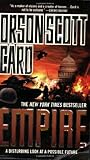
Book Review: Empire (Orson Scott Card)

Don't let the bad photoshop fool you... this is a wicked-awesome book!Anyone who reads Orson Scott Card – the author of the insanely awesome Ender saga – knows that he’s one of the best Science Fiction writers around.  His stories reflect what is best and worst about our natures, and use gripping, thrilling, so-awesome-you-have-to-read-it-twice narrative to do it.

Empire is no different.  It’s the story of the Second American Civil War.

The book feels as though it’s set tomorrow.  Foreign terrorists assassinate the President and Vice President, and shortly thereafter a group of either right- or left-wing radicals take over New York City, declaring themselves to be the liberators of America.  States quickly move to choose sides and the fighting begins.

What makes Card’s tale so compelling is the frightening plausibility of it.  Card’s America is as sharply divided along party lines as is ours, so this war is not fought across the Mason-Dixon line; instead, it’s red-state/blue-state, urban/rural.  The divisive, divided rhetoric could be taken from any number of email forwards so lovingly sent around – not to mention FOX News or CNN.

Perhaps most intriguing is Card’s comparison of America to Rome – not the Empire, but the Republic.

Card argues – through one of his more interesting characters – that America is not an Empire because were we to disappear as a nation today, our culture would not endure in the world the way Rome’s did.  Rather, America exists as did Rome at the end of her republic phase: broken by infighting and divisions, unable to stand strong on the world stage.

Only when Rome was united under a strong leader was she able to become probably the greatest empire the world had ever known.  And so Card begs us to ask, Will we follow those currents of history, ride along in Rome’s wake?

One of the more inflamatory passages in the book sums his probing well: “We don’t want individual liberty because we don’t want individual responsibility.  We want somebody else to take care of us.  If we had a dictator who did a better job of it than our presenty system, then as long as he pretended to respect Congress, we’d lick his hands like a dog.

Bottom line: A great, quick thriller that will make you rethink your politics.

Bonus!  Card just released a sequel called Hidden Empire.  I can’t wait to read it!

Book Review: Gone Baby Gone by Dennis Lehane

If you haven't read Lehane yet, don't start here.  But start right away!  And get here ASAP!Gone Baby Gone is Dennis Lehane’s fourth novel to feature crack private investigators Patrick Kenzie and Angela Gennaro.  It follows on the heels of Sacred, in which Kenzie and Gennaro finally consummate their long-anticipated romance.  They are called to augment the police investigation into the kidnapping of five-year-old Amanda McCready.  The book quickly descends into Lehane’s trademark twists and turns, with the detectives enmeshed in an ever-more-maddening series of betrayals and reversals.

As with all of Lehane’s work, Gone Baby Gone has more going on beneath the surface than you might be expecting.  Sacred was a meditation on the nature of beauty, while Shutter Island explored how we construct meaning and purpose in our lives.  Gone Baby Gone asks us how free our wills really are.  Kenzie affirms that it’s where we come from, how we were raised that forms our decisions.  The thrust of the narrative disagrees, however.  Characters repeatedly make choices based less on where they’re from than the events and stories into which they’ve been thrust.  And as the narrative winds and flows towards its shocking but (in retrospect) inevitable conclusion Kenzie is forced to make a choice.

And choose Patrick Kenzie does.  With devastating results.

But the real catch is that there’s no right answer.  Gone Baby Gone is Lehane’s Gordian Knot and he’s seen fit to deprive his readers of a sword.  You’ll be left broken and frustrated.

And in case you’re curious, the film (directed by Ben Affleck – yeah, that Ben Affleck) is just as good.  But is saying something just so slightly (but significantly) different from the book.  It’s worth the watch.  But don’t watch it alone.  Because you will need to discuss it as soon as it’s over.