A couple of weeks ago, I offered my favorite iPhone apps. But since all work and no play makes Jack a dull boy, here are the games that keep me entertained. Nearly every game has a lite or free version you can get to try it out first. But they’re all worth the (meager) price you’ll pay.
Zombie Smash
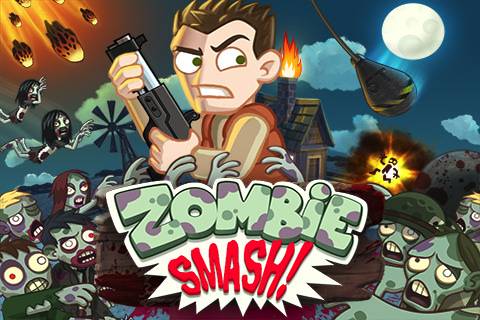
Zombie Smash is a fun, addictive game in which you’re defending your homestead from hungry legions of undead. How? By flinging them with your thumbs. It’s got a great set of up-gradable weapons, quite a few types of zombies (each with its own characteristics) and difficulty settings to keep it plenty tough. Plus they keep putting out upgrades for it, so the fun never stops!
Plants vs. Zombies + geoDefense

 Okay, you caught me. I’m minorly obsessed with Zombies. But I grouped these two games together because they’re two of the best tower-defense games out there. In PvZ, you’re a homeowner who purchases increasingly deadly plants from your crazy neighbor to fend off the hoards of undead (who of course want to eat your brains). gD is a much simpler game in which you construct turrets to destroy wave after wave of geometric shapes (each with their own speed/strength). Both are challenging and addictive; they’ll keep you entertained (or, quite possibly, frustrated) for hours.
Angry Birds
 This is one of the most popular games out there right now (if Twitter and sales have anything to say about it). Two minutes of play will show you why. Evil pigs have stolen your eggs, so you do what any bird naturally would: you hurl yourself (via a slingshot you aim with your finger) at the pigs’ homes and castles in order to destroy them. You have four different kinds of birds and these levels are hard. You’ll have plenty of time to work on them, because once you download this game, it’s not like you’ll be working.
DoodleJump
 Speaking of reasons you’ll never work again, meet DoodleJump. This game is advertised as the most addictive game on the iPhone and they may be right. The gameplay is impossibly simple. You jump from platform to platform, steering your jumper by tilting the phone back and forth. Tap the screen to shoot monsters (or jump on them) and that’s it. The game has several different skins (space, undersea, world cup, Halloween, etc.) that change the gameplay ever-so-slightly to keep things interesting. I’ve only owned the game for about a month now, and my friends and I have already dumped several hours into it. Did I mention it’s addictive?
Words With Friends/ Chess With Friends


Scrabble is one of the most maddening games imaginable. How are you supposed to make a word with three O’s, an A, E, X and Q? Well, I can’t, which is why I always lose. So what better reason to play against me? Create an account and get started. Find a partner and then play as often as you like – each person will be notified when it’s his/her turn, and you can take as long as you need to find that killer word. I wish more than two persons could play a single game, but it’s still tremendous fun. My user name is jrforasteros, if you want to play (and if you’re a chess player, it’s equally fun).
SkiBall + Paper Toss


Both of these games are also good, simple fun. They both have the same gameplay – you swipe your finger across the screen to throw your skiball or paperwad. SkiBall is a blast, and just like in real skiball, you collect tickets you can redeem for prizes. I already bought Manda and panda bear and now I’m saving up for an 8-ball skiball. Paper Toss is perfect for the office – you are trying to become the world champion paper-tosser, throwing paperwads into a trashcan (taking into account the wind currents created by the fan). Since both games track high scores, you’ll constantly be fighting with your friends to maintain your first-place status.
Flood-It!

Last, but by no means least is Flood-It! Again, the gameplay is pretty simple. You’re presented with a board comprised of squares of six different colors. You begin in the top-left corner and change the color of the squares until the whole board is one color. Oh, and you have an extremely limited number of moves. If you like puzzle games, don’t miss this one.

 We have a lot of visitors to EPIC week in and week out, and a lot of them are ‘church-shopping’ – they’re already believers and are trying to find a church that ‘meets their needs’. These are also the people who are most likely to come talk to me after our gathering, to tell me what they thought of my communication. And, God help me, I get (a sick) pleasure when they tell me that I’m better than another minister.
 No surprise that Google would put out a great mobile app. It’s got a voice search feature and is pretty well-integrated with the full range of Google apps (mail, reader, ect., including the Maps app that comes on the phone). Keeps you connected and informed – everything you need to thrive on Web 2.0.







 This Jesus is so distant and aloof that he can’t engage our lives in a meaningful way. And it’s not the Jesus we meet in the Scriptures. Jesus’ holiness was not a detachment from the people around him. Jesus’ interactions with the unholy didn’t contaminate him, didn’t make him unclean. Rather, his holiness was contagious. He touched the unclean and made them clean, whole.

 Sacrificial Lamb Jesus came to die for your sins.